I have an HP3 at the shop being looked at; it was giving me problems intermittently [but reliably] - every so often the C, E, and G# notes [of all
octaves] would act up [either they'd sound metallic and disproportionately loud, or they'd make no sound at all].
The repair person looking at the keyboard was not able to reproduce the problem [of course], but after conferring with a colleague, he told me
he believes the trouble has something to do with the "IC scanners" in the instrument.
I'm not a technical person. Has anyone here heard of this type of problem, or know anything about "IC scanners" [and whether the diagnosis
sounds correct?]
Cheers and thanks.
HP3 being repaired
-
howardwheat
- Posts: 7
- Joined: 05 Jan 2013, 23:55
- 13
- Your Nord Gear #1: Nord Electro 3
- Your Nord Gear #2: Nord Electro 2
- Has thanked: 3 times
- Been thanked: 3 times
-
mjbrands
Re: HP3 being repaired
Yes, I've heard of this issue. Feel free to skip all the techno mumbo-jumbo below and go to the last paragraph. 
For every key (73 in your case) there are two switches: one that senses when you press a key partially down (lets call this high) and another one that senses when you've pushed it down fully (lets call this low).
When press a key down, first the high switch closes and then (a fraction of a second later) the low switch closes. The time between the two switches closing is used to calculate how quickly (velocity) you pressed the key down, which is also a measure for how much force you used (more force, key goes down faster).
If one of the two switches does not work, you get problems. If the high switch does not work, the Nord only sees the low switch pressed and this results in maximum velocity. If the low switch does not work, it will appear as if you didn't press the key down all the way and this will result on a missing key press (zero velocity). Single switches failing could be caused by dirt in the keybed, for example; this is the typical 'velocity problem' and you should be able to find quite a bit of info on the forum about this.
Your case is more complex though: multiple keys have issues.
Note that when playing organ sounds, the Nord only uses either the high or the low switch; which one is used can be configured in the system menu. I'm not an organ player, but as I understand it using the high switches allows for a more authentic feel and playing style. Since only a single switch is used per key, the Nord cannot determine velocity. I think it will send out MIDI data with maximum velocity when playing an organ on a Nord. This also explains why (in general) using a C1 or C2 organ as a MIDI controller is not ideal, although there might be a way to get the C1/C2 to send velocity data, since the keyboard does actually contain both a high and low switch for every key and the hardware in the C1/C2 is actually able to 'read' both switches.
Since every key has two switches, there are 146 switches (2 x 73) in total; in reality there are more, since there are also quite a few switches on the top panel. If the processor had to check for 146+ switches whether they were closed or not, it would need quite a large number of inputs and the circuit boards in your Nord would become rather complex (and expensive). Instead, they create a button matrix.
Imagine a keyboard with 16 keys in total. If you want to check which keys are pressed, the easiest way would be a micro controller (think a fairly simple processor/CPU) with at least 16 inputs. It can be done in a much smarter way though; you could divide those 16 keys up into 4 groups (A thru D) of 4 keys (1 thru 4). This is shown in figure 1.
Figure 1
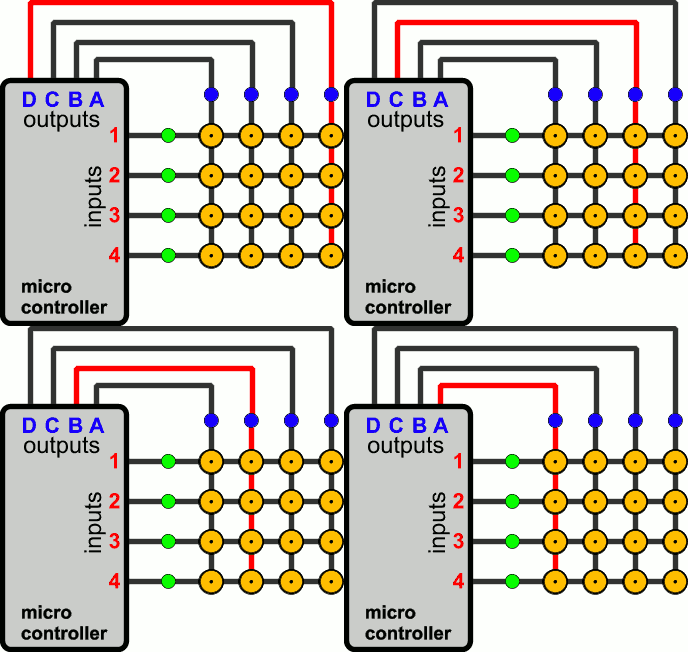
The micro controller will cycle through its outputs (A thru D) and send a signal out the outputs, one at a time. Note figure one shows it going through the outputs in reverse order, D down to A and then back to D again.
If a key is pressed, as some point the micro controller will receive a signal on one of its inputs (1 thru 4). Figure 2 shows how this works. The purple key (C3) is pressed. When the micro controller sends the signal via output C, it receives it back via input 3 - it then knows key C3 must be pressed. As can be seen in figure 1, the micro controller is effectively scanning rows of switches, going from right to left. If C1 were also pressed, it would receive the signal on both inputs 1 and 3 as soon as output C is used.
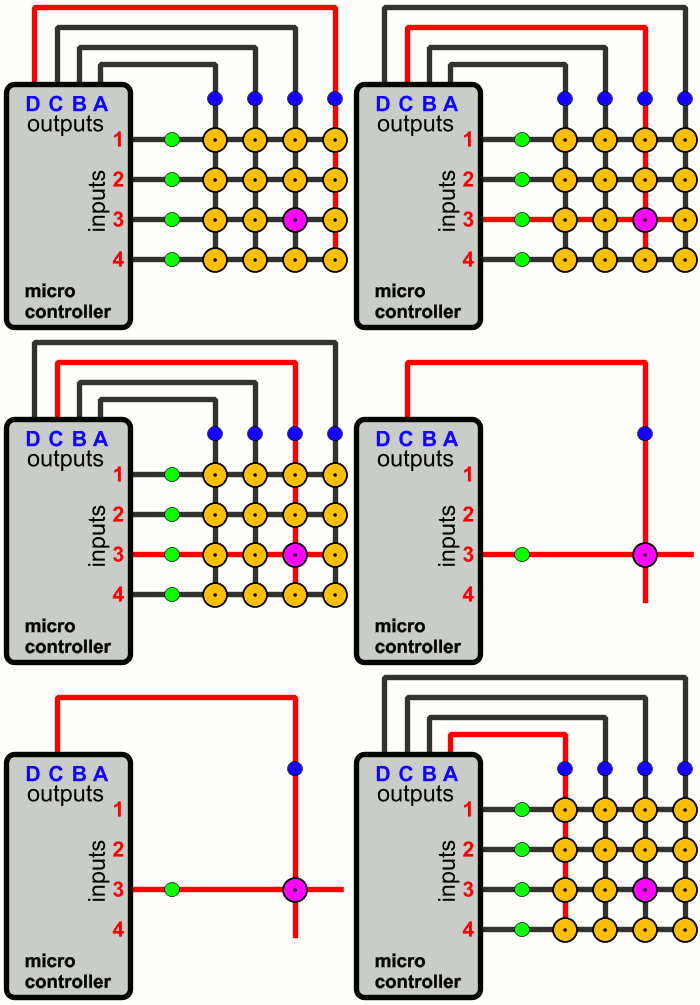
This site has more information (the animations also come from that site): http://pcbheaven.com/wikipages/How_Key_Matrices_Works/
For this imaginary keyboard with 16 keys, we only need 4 outputs and 4 inputs (a 4x4 button matrix), so 8 in total; compare that with the 16 of the simplest solution (a single input for every key). As the number of switches (keys) increases, the 'savings' you can achieve with a button matrix (8 in this example, so 50%) gets larger and larger. For example, for 73 switches, you could use a 7x12 (84 possible switches, 7+12=19 in/outputs), 8x10 (80 switches, 18 in/outputs) or 9x9 (81 switches, 18 in/outputs).
A 7x12 button matrix would be easy to understand. The outputs can be seen as the octave (1 thru 7) and the inputs could be the keys in an octave (C thru B, A thru G#, etc.). The micro controller would essentially be scanning the keys one octave at a time. If it would do this many thousands of times per second, it would appear as if it was able to check all switches at the same time.
A 12x7 button matrix is similar. The outputs would be the keys in an octave (C thru B) and the inputs the different octaves. The micro controller would essentially be checking all Cs, then all C#s, then all Ds, etc.
Most likely the button matrix used isn't actually 7x12 or 12x7. I think they used 2-3 chips to read the switches (keys + control panel) on the Electro 2, so this is probably the case for all Nords.
TL;DR
In your case, it could be a defective diode (see the page I linked above), an issue with one of those chips that scans the switches or perhaps an issue with the cables that connects the switches in the keyboard to those chips 'scanning' them. Based on the exact pattern of the failures you see, you can probably rule out specific causes (i.e. rule out it cannot be a defective diode). In your case they seem to have concluded one of those chips (ICs) is defective, so they'll probably replace the main circuit board in your Nord.
For every key (73 in your case) there are two switches: one that senses when you press a key partially down (lets call this high) and another one that senses when you've pushed it down fully (lets call this low).
When press a key down, first the high switch closes and then (a fraction of a second later) the low switch closes. The time between the two switches closing is used to calculate how quickly (velocity) you pressed the key down, which is also a measure for how much force you used (more force, key goes down faster).
If one of the two switches does not work, you get problems. If the high switch does not work, the Nord only sees the low switch pressed and this results in maximum velocity. If the low switch does not work, it will appear as if you didn't press the key down all the way and this will result on a missing key press (zero velocity). Single switches failing could be caused by dirt in the keybed, for example; this is the typical 'velocity problem' and you should be able to find quite a bit of info on the forum about this.
Your case is more complex though: multiple keys have issues.
Note that when playing organ sounds, the Nord only uses either the high or the low switch; which one is used can be configured in the system menu. I'm not an organ player, but as I understand it using the high switches allows for a more authentic feel and playing style. Since only a single switch is used per key, the Nord cannot determine velocity. I think it will send out MIDI data with maximum velocity when playing an organ on a Nord. This also explains why (in general) using a C1 or C2 organ as a MIDI controller is not ideal, although there might be a way to get the C1/C2 to send velocity data, since the keyboard does actually contain both a high and low switch for every key and the hardware in the C1/C2 is actually able to 'read' both switches.
Since every key has two switches, there are 146 switches (2 x 73) in total; in reality there are more, since there are also quite a few switches on the top panel. If the processor had to check for 146+ switches whether they were closed or not, it would need quite a large number of inputs and the circuit boards in your Nord would become rather complex (and expensive). Instead, they create a button matrix.
Imagine a keyboard with 16 keys in total. If you want to check which keys are pressed, the easiest way would be a micro controller (think a fairly simple processor/CPU) with at least 16 inputs. It can be done in a much smarter way though; you could divide those 16 keys up into 4 groups (A thru D) of 4 keys (1 thru 4). This is shown in figure 1.
Figure 1
The micro controller will cycle through its outputs (A thru D) and send a signal out the outputs, one at a time. Note figure one shows it going through the outputs in reverse order, D down to A and then back to D again.
If a key is pressed, as some point the micro controller will receive a signal on one of its inputs (1 thru 4). Figure 2 shows how this works. The purple key (C3) is pressed. When the micro controller sends the signal via output C, it receives it back via input 3 - it then knows key C3 must be pressed. As can be seen in figure 1, the micro controller is effectively scanning rows of switches, going from right to left. If C1 were also pressed, it would receive the signal on both inputs 1 and 3 as soon as output C is used.
This site has more information (the animations also come from that site): http://pcbheaven.com/wikipages/How_Key_Matrices_Works/
For this imaginary keyboard with 16 keys, we only need 4 outputs and 4 inputs (a 4x4 button matrix), so 8 in total; compare that with the 16 of the simplest solution (a single input for every key). As the number of switches (keys) increases, the 'savings' you can achieve with a button matrix (8 in this example, so 50%) gets larger and larger. For example, for 73 switches, you could use a 7x12 (84 possible switches, 7+12=19 in/outputs), 8x10 (80 switches, 18 in/outputs) or 9x9 (81 switches, 18 in/outputs).
A 7x12 button matrix would be easy to understand. The outputs can be seen as the octave (1 thru 7) and the inputs could be the keys in an octave (C thru B, A thru G#, etc.). The micro controller would essentially be scanning the keys one octave at a time. If it would do this many thousands of times per second, it would appear as if it was able to check all switches at the same time.
A 12x7 button matrix is similar. The outputs would be the keys in an octave (C thru B) and the inputs the different octaves. The micro controller would essentially be checking all Cs, then all C#s, then all Ds, etc.
Most likely the button matrix used isn't actually 7x12 or 12x7. I think they used 2-3 chips to read the switches (keys + control panel) on the Electro 2, so this is probably the case for all Nords.
TL;DR
In your case, it could be a defective diode (see the page I linked above), an issue with one of those chips that scans the switches or perhaps an issue with the cables that connects the switches in the keyboard to those chips 'scanning' them. Based on the exact pattern of the failures you see, you can probably rule out specific causes (i.e. rule out it cannot be a defective diode). In your case they seem to have concluded one of those chips (ICs) is defective, so they'll probably replace the main circuit board in your Nord.
-
pablomastodon

- Patch Creator
- Posts: 4390
- Joined: 30 Apr 2010, 20:45
- 15
- Your Nord Gear #1: Nord Stage 3
- Your Nord Gear #2: Nord Wave
- Has thanked: 1895 times
- Been thanked: 1971 times

Re: HP3 being repaired
As usual, MJ hits the proverbial nail on the head wrt many points (and WAY over the top in technical, but useful, detail), but I like to add a couple things:
scanning IC failure is very probably the culprit
those ICs are available on the open market at ~3pcs for US$1
techs with skills can replace those without too much difficulty -- a MUCH more economical solution than swapping an entire mainboard.
pablo
scanning IC failure is very probably the culprit
those ICs are available on the open market at ~3pcs for US$1
techs with skills can replace those without too much difficulty -- a MUCH more economical solution than swapping an entire mainboard.
pablo
- These users thanked the author pablomastodon for the post:
- howardwheat
bun fyah weh fyah fi bun
-
mjbrands
Re: HP3 being repaired
It surprises me they (motherboards) are actually fixed, especially since those chips are probably SMD components. Sure, I know they can be replaced, but labour is not free. A skilled technician with the right tools could probably do it in 20-30 minutes, including opening the instrument and testing afterwards.pablomastodon wrote:techs with skills can replace those without too much difficulty -- a MUCH more economical solution than swapping an entire mainboard.
<rant>
Anyway, a button on a pretty expensive Dell display failed because a bit of moisture leaked behind the bezel when I was cleaning it. I asked Dell if they could fix it and if so, what it would cost.
They said they could fix it and the asking price made me jump out of my seat. I then asked them what a new one would cost: exactly the same as what they quoted for the 'fix' (and quite a bit higher than street price). When I asked them about this, they pretty much said they don't repair equipment in cases where Dell is not to blame and that they would only offer a replacement at list price. My replacement monitor was not a Dell.
</rant>
Last edited by mjbrands on 10 Oct 2013, 14:50, edited 1 time in total.