Starting a DAW recording project. Keys will be the most prominent instrument and most songs will feature piano. I have a Nord Electro 6d that I can just plug into the interface. The grand piano sound on it is great. But my mom actually has a real grand piano. She still plays, so she keeps it tuned and it has a humidifier in it and everything. But it is in a big room with hard wood floors. Never recorded in there, but I imagine it is boomy. The interface I am using has four mic inputs, but I don't have four good mics. I would probably only mic the grand in two places.
So what should I do? It seems silly to use a grand piano imitation when I have access to a real grand piano. On the other hand, the nord engineers created the sound by micing a grand piano way better than I ever could.
DAW Recording Grand Piano sounds
-
playsabadguitar
- Posts: 61
- Joined: 10 Nov 2021, 16:03
- 4
- Your Nord Gear #1: Nord Electro 6
- Location: western mass
- Has thanked: 56 times
- Been thanked: 10 times

DAW Recording Grand Piano sounds
Nord Electro 6D-->Soundcraft 12fx mixing board-->QSC 12.2 powered speaker
-
DJKeys

- Patch Creator
- Posts: 2181
- Joined: 11 Apr 2011, 17:11
- 15
- Your Nord Gear #1: Nord Stage 3
- Your Nord Gear #2: Nord Wave 2
- Location: Las Vegas
- Has thanked: 436 times
- Been thanked: 886 times
Re: DAW Recording Grand Piano sounds
If you don't have good microphones, just use the Electro. It's a lot easier, as the recording has already been done for you. Plus, you have many different pianos to choose from.
Trying to get a good recording of a grand piano in a live room is not an easy task, even for an experienced engineer.
-dj
Trying to get a good recording of a grand piano in a live room is not an easy task, even for an experienced engineer.
-dj
Last edited by DJKeys on 01 Dec 2022, 22:48, edited 2 times in total.
- These users thanked the author DJKeys for the post:
- playsabadguitar
Nord Stage 3
Nord Wave 2
Yamaha U3
iMac i7 Sequoia
Fender Studio Pro 8
Nektar T4
Drawmer DL 241
Focusrite ISA Two
Focusrite Clarett 8 Pre
-
Schorsch
- Moderator
- Posts: 2723
- Joined: 15 May 2018, 23:34
- 7
- Your Nord Gear #1: Nord Stage 3
- Your Nord Gear #2: Nord Stage 3
- Location: Germany - NRW
- Has thanked: 1584 times
- Been thanked: 1005 times

Re: DAW Recording Grand Piano sounds
Good miking of a grand piano is an art, this is not easy. You will get much better results using a well sampled piano sound, either one of the Nord pianos or a good virtual piano plugin. However, without a good hammer action it would also be difficult to play in all nuances a good piano sample is capable of - if you know what I mean
- These users thanked the author Schorsch for the post:
- playsabadguitar
Regards Schorsch
Check this https://chris55.github.io/ns3-program-viewer/ awesome tool to visualize NS2/3 programs and re-create them on the other instrument!
Gear: NS3C, Uhl X4V-1, 2-manual HX3.4 organ made by Tastendoktor, SL88 Studio
Check this https://chris55.github.io/ns3-program-viewer/ awesome tool to visualize NS2/3 programs and re-create them on the other instrument!
Gear: NS3C, Uhl X4V-1, 2-manual HX3.4 organ made by Tastendoktor, SL88 Studio
-
Mathlau

- Posts: 3
- Joined: 15 Sep 2018, 10:29
- 7
- Your Nord Gear #1: Nord Stage 2
- Your Nord Gear #2: Nord Electro 6
- Location: Aix-en-Provence
- Has thanked: 3 times
- Been thanked: 1 time

Re: DAW Recording Grand Piano sounds
(translation of an article (https://fr.audiofanzine.com/microphone/ ... piano.html)
Record your piano well
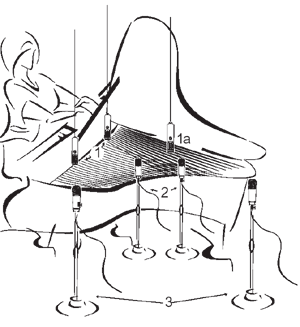
The placement of stereo microphones on a piano partly depends on the musical style performed.
The very wide frequency range of the piano combined with its large dimensions makes the stereo sound recording with one or more paired couples obvious. Pickup placement has a lot to do with the type of tone you're looking for.
In most cases, the cover will need to remain open throughout the recording. When isolation is needed, many sound engineers set the cover halfway up and place a moving blanket in the opening to isolate the mics.
1. Pop/rock
The closer the pickups are placed to the hammers, the more punchy the sound seems. This is why in recordings where the piano is to be heard above the other tracks, we often perform a close miking of the hammers. Start by placing a matched pair of downward-angled cardioid mics about six inches above the hammers, with each mic positioned about one-third the distance between the first and last hammer. Be careful not to place them too close to the hammers vertically to avoid the capture field being restricted to only one part of the required note range. Vary the distance between the pickups until you achieve the desired balance between wide stereo imaging and even response across the range. You may also need to increase the angle of the mics slightly to improve separation. Change the gap to the hammers to achieve the desired balance between punchy attack and amplitude. You can also try moving the pickup away from the low region by placing it farther from the hammers, towards the soundboard. thus a fuller and warmer sound (see position 1a of the diagram).
2. Ballads pop/jazz
Jazz and pop ballads generally require the fuller sound you get by moving the pickups further away from the hammers. Deep in the curved part of the instrument, position a paired pair of cardioids so as to form a 45 degree angle. One of the microphones should face the performer while the other should face the soundboard. Start with a gap of 7.5 to 15 cm, reducing the angle if you separate the microphones further. It's also a good idea to try an X-Y setup or any other coincident mic setup. In the vertical axis, the microphones should be placed halfway between the strings and the open cover.
3. Classical piano or solo
The classical piano and the solo piano benefit from being recorded with the technique of remote sound recording, which makes it possible to better capture the atmosphere of a concert. Try to place the microphones 1m20–2m50 from the curved part of the piano, and at a height of 1m50–3m60. To establish the optimal position of the microphones, the following factors must be taken into account: size and model of the piano, acoustic space and the amount of acoustic space to be captured. The closer the microphones are placed to each other, the more intimate the sound. Conversely, the further apart they are, the fuller the sound. As always, the cardioids put the accent more on the instrument while the omnis open up on the room (which must therefore have satisfactory acoustics).
Some engineers like to add another microphone under the piano, facing the soundboard, to capture the warm, velvety sound of wood. If you have enough condenser mics, try placing a stereo pair on top of the instrument for close miking. below and a paired couple to capture the atmosphere of the room.
The recommended use of several microphones with concert grand pianos is very likely to cause phase problems in all the cases mentioned. For all stereo sound recordings, make sure that there are no phase problems or mono in¬compatibility.
Record your piano well
The placement of stereo microphones on a piano partly depends on the musical style performed.
The very wide frequency range of the piano combined with its large dimensions makes the stereo sound recording with one or more paired couples obvious. Pickup placement has a lot to do with the type of tone you're looking for.
In most cases, the cover will need to remain open throughout the recording. When isolation is needed, many sound engineers set the cover halfway up and place a moving blanket in the opening to isolate the mics.
1. Pop/rock
The closer the pickups are placed to the hammers, the more punchy the sound seems. This is why in recordings where the piano is to be heard above the other tracks, we often perform a close miking of the hammers. Start by placing a matched pair of downward-angled cardioid mics about six inches above the hammers, with each mic positioned about one-third the distance between the first and last hammer. Be careful not to place them too close to the hammers vertically to avoid the capture field being restricted to only one part of the required note range. Vary the distance between the pickups until you achieve the desired balance between wide stereo imaging and even response across the range. You may also need to increase the angle of the mics slightly to improve separation. Change the gap to the hammers to achieve the desired balance between punchy attack and amplitude. You can also try moving the pickup away from the low region by placing it farther from the hammers, towards the soundboard. thus a fuller and warmer sound (see position 1a of the diagram).
2. Ballads pop/jazz
Jazz and pop ballads generally require the fuller sound you get by moving the pickups further away from the hammers. Deep in the curved part of the instrument, position a paired pair of cardioids so as to form a 45 degree angle. One of the microphones should face the performer while the other should face the soundboard. Start with a gap of 7.5 to 15 cm, reducing the angle if you separate the microphones further. It's also a good idea to try an X-Y setup or any other coincident mic setup. In the vertical axis, the microphones should be placed halfway between the strings and the open cover.
3. Classical piano or solo
The classical piano and the solo piano benefit from being recorded with the technique of remote sound recording, which makes it possible to better capture the atmosphere of a concert. Try to place the microphones 1m20–2m50 from the curved part of the piano, and at a height of 1m50–3m60. To establish the optimal position of the microphones, the following factors must be taken into account: size and model of the piano, acoustic space and the amount of acoustic space to be captured. The closer the microphones are placed to each other, the more intimate the sound. Conversely, the further apart they are, the fuller the sound. As always, the cardioids put the accent more on the instrument while the omnis open up on the room (which must therefore have satisfactory acoustics).
Some engineers like to add another microphone under the piano, facing the soundboard, to capture the warm, velvety sound of wood. If you have enough condenser mics, try placing a stereo pair on top of the instrument for close miking. below and a paired couple to capture the atmosphere of the room.
The recommended use of several microphones with concert grand pianos is very likely to cause phase problems in all the cases mentioned. For all stereo sound recordings, make sure that there are no phase problems or mono in¬compatibility.