leonardo 1 wrote:When I say bass I mean bass .. Sorry for the translation .. (middle and bass highs) .. I've tried all the ep and the only one is actually the bright ep5 .. That's more balanced .... The same is true for the acoustic pianos ... First there were not all the low ones ... If I put it in layers with a Pad it's almost scary !!
@leonardo1, I took some time to do a controlled test here. I recorded the EP2 (and EP4) at 4 different velocities (30, 60, 90 and 120) for middle F (F4), C3 and finally at F1 (the lowest F) on both my NS3 with 2.00 and EPs version 6, and on my NE6 using the version 5 EPs. The sound engine in the two devices are very similar, so it's a good test comparing version 5 and 6 EPs to check for any substantial differences.
When normalising to the same output levels between the two devices, I can plot the RMS value of each tone. Note that the RMS level corresponds to the energy content of the sample. It looks like this:
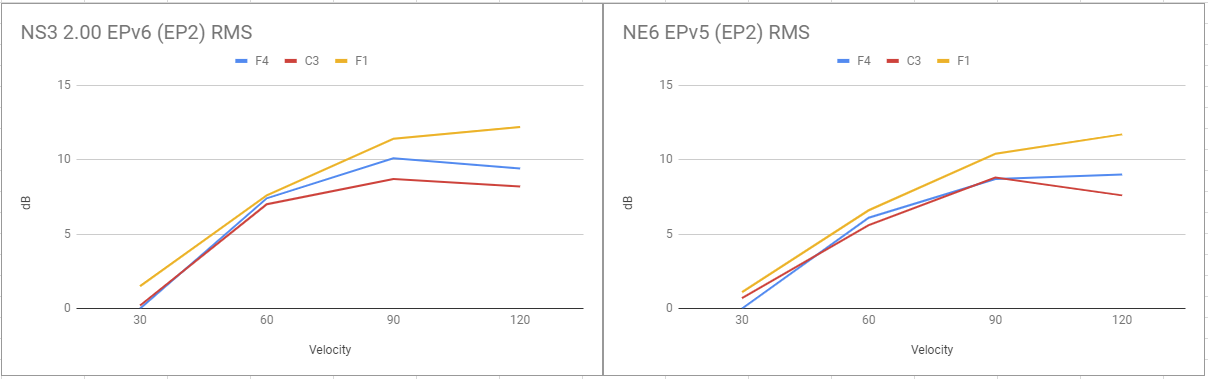
- RMS level vs Velocity
- RMS_vs_Velocity.PNG (32.41 KiB) Viewed 1680 times
As you can see, there are some small differences, which is likely due to the adjusted curves and new samples, but the energy levels are within +1.4/-0.5 dB for the tones I tested.
I also looked at the differences when plotting only the level of the fundamental frequency (F4, C3 and F1, respectively). It looks like this:

- Fundamental Frequency level vs Velocity
- Fundamental_vs_Velocity.PNG (34.19 KiB) Viewed 1680 times
The differences are here a little larger, +3.1/-0.6 dB, which indicates that even if the RMS levels (energy content) are quite similar, the tonal spectrum may look different.
To test this, I took the tones that had the largest differences (F1 at velocity 90) and calculated the frequency spectrum for the fundamental frequency and the next 7 overtones, i.e. 8
harmonicsin total from n=1 to n=8.
It looks like this:
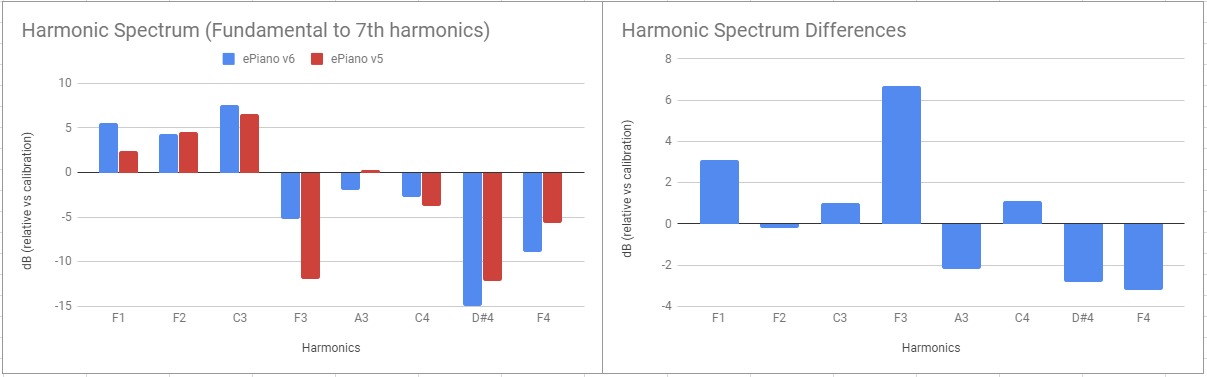
- Harmonic Spectrum (F1 velocity 90)
- Harmonic_Spectrum.PNG (27.56 KiB) Viewed 1680 times
To the left, the levels are plotted independently, relative to the overall baseline (F4 RMS level at velocity 30). To the right, I've compared the two tones, and only plot the difference at each harmonic.
As you can see, the fundamental (F1) and the 3rd overtone (4th harmonics, F3) are somewhat more energy rich, up to +6.7 dB stronger in the v6 sound. Other harmonics, in particular the higher frequency ones, are somewhat attenuated, down to -3.2 dB.
It is possibly that the largest part of the difference is simply in how the sample switching may have changed or new (and better, in my view) samples have been used.
The tentative conclusion, for the tones I tested, is that the overall energy content is quite similar also in the low end, so the overall balance hasn't changed that much.
The overtone spectrum (of the EP2) may have changed somewhat, with a bit stronger fundamental and 4th order harmonics and a bit less high end content. Taking into account how the ear perceives sound levels, the v6 actually would sound 1 dB weaker without compensation (for this tone), but since there is a small positive adjustment in the overall level, they end up SOUNDING as if they were at the same loudness level (i.e. similar db(A) level).
Now, to my ears, the v6 sound a little more bass heavy (as I also measure, due to the increased 1st and 4th order harmonics) -- and as you also say. But if you need -15 dB adjustment in the low end, there is something terribly wrong. The actual differences are MUCH smaller than this, and is largely a matter of taste, I think. Something like maybe a -3 dB lower end cut should be more right.
If you, by the way use the speaker amp, then much of the lowend (v5 and v6) goes away.
Hope this helps to clarify a bit what goes on.